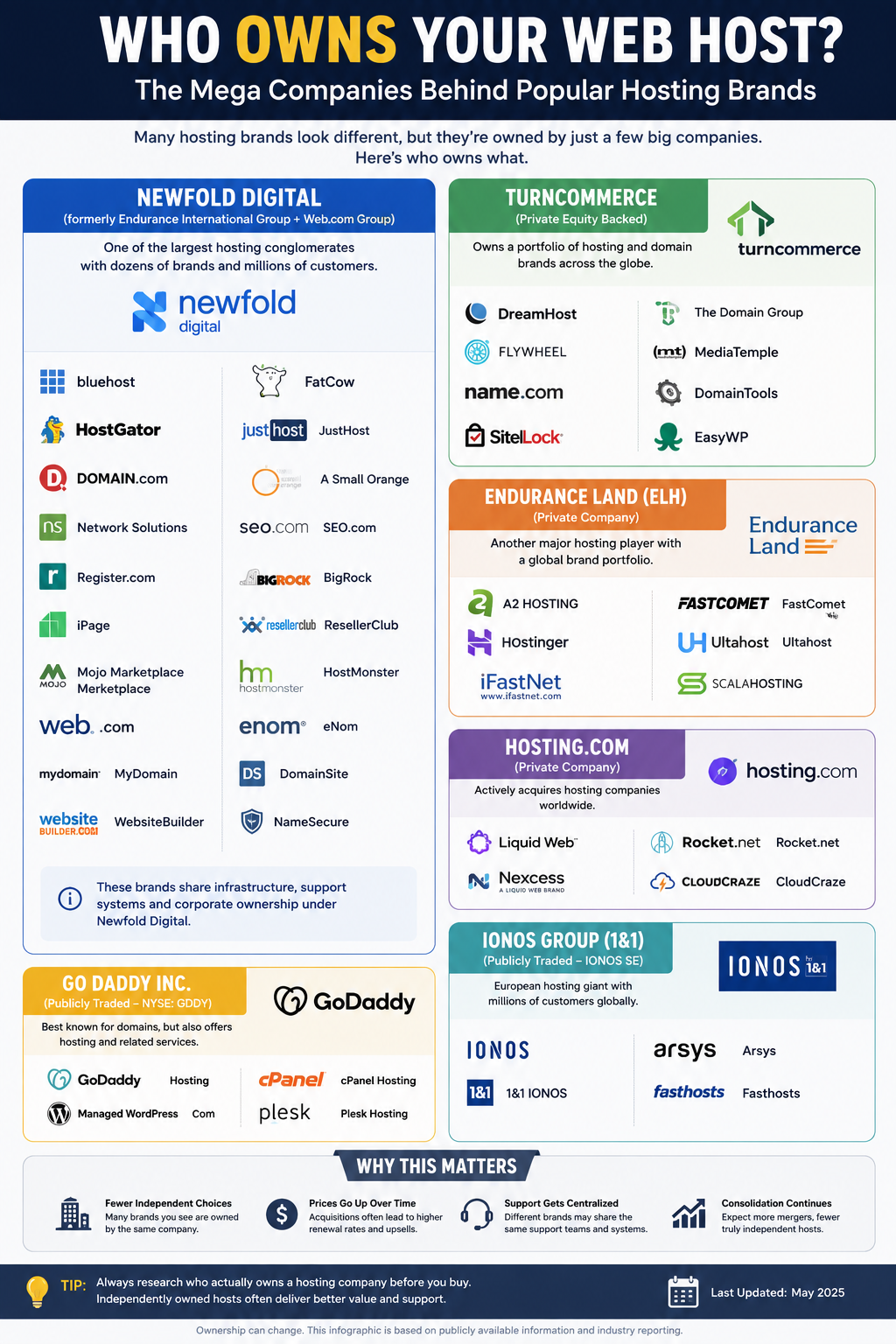
For years, the web hosting industry looked incredibly competitive on the surface. Hundreds of brands promised faster speeds, lower prices, unlimited bandwidth, better support, and “the best hosting for WordPress.” But behind the scenes, something very different was happening. Quietly and steadily, a handful of giant corporations and private equity firms began buying up independent hosting companies at an aggressive pace. The logos stayed different. The websites looked different. The marketing sounded unique. But ownership kept consolidating into fewer and fewer hands.
Today, many website owners believe they are comparing multiple hosting companies when in reality they are often choosing between brands owned by the exact same parent corporation. That consolidation is reshaping the hosting industry in ways consumers are finally beginning to notice: rising renewal prices, more aggressive upsells, declining support quality, reduced innovation, and fewer genuinely independent choices.
One of the biggest examples is Endurance International Group, better known to many longtime developers as EIG. The company became infamous in web development communities for acquiring large numbers of hosting providers and consolidating them under one corporate umbrella. In 2021, EIG merged with Web.com to form Newfold Digital, which now controls a massive portfolio of hosting and domain brands including Bluehost, HostGator, Domain.com, Network Solutions, iPage, and many others.
For average customers, the consolidation often goes unnoticed because the branding remains separate. Bluehost looks like Bluehost. HostGator looks like HostGator. But many of these brands now operate on shared infrastructure, use centralized support systems, and follow nearly identical pricing strategies. Critics argue this creates the illusion of competition while reducing actual consumer choice.
Developers and industry observers have been warning about this trend for years. Numerous independent hosting forums and technical blogs describe a predictable cycle that happens after acquisitions. A respected hosting company builds a loyal customer base through strong support and reliable infrastructure. Then a larger corporation acquires it, migrates customers onto consolidated systems, reduces operational costs, standardizes support, and pushes more upsells and long-term contracts. Over time, many customers notice slower performance, longer support wait times, and rising prices.
The economic incentives behind these mergers are obvious. Hosting companies generate recurring monthly revenue, making them extremely attractive to private equity firms and investment groups. Once a hosting company has thousands or millions of subscribers paying every month, it becomes a predictable cash-flow business. Investors love predictable cash flow. The easiest way to increase profits after an acquisition is often not innovation, but consolidation: fewer support staff, fewer data centers, shared infrastructure, and aggressive cross-selling of add-ons like backups, SSL certificates, security packages, email hosting, and SEO tools.
Industry analysts have openly predicted this consolidation trend for years. Even older market reports described hosting as an industry primed for mergers because companies were chasing scale, international reach, and recurring revenue. What has changed recently is the speed and scale of consolidation. The rise of cloud infrastructure providers like AWS, Microsoft Azure, and Google Cloud has dramatically increased competitive pressure on traditional hosting companies. Smaller hosts now struggle to compete with the infrastructure capabilities and pricing power of massive cloud providers.
As a result, the middle of the market is disappearing. Independent shared hosting companies either get acquired, shut down, or attempt to survive by focusing on niche audiences and premium support. The industry increasingly resembles what happened in airlines, telecommunications, media, and even grocery stores: lots of brands on the surface, but ownership concentrated among a shrinking number of corporate groups.
Consumers are beginning to feel the impact directly through pricing. Introductory hosting plans still appear cheap at first glance, often advertised at only a few dollars per month. But renewal rates have climbed aggressively. Many hosting brands now lock users into multi-year contracts with low initial pricing before sharply increasing rates at renewal. Some hosting plans renew at two or three times the original promotional cost.
Upselling has also intensified across the industry. Customers signing up for basic hosting are frequently pressured into purchasing security add-ons, malware scanning, premium support, SEO packages, backups, domain privacy, email tools, and optimization services. What once felt like straightforward web hosting increasingly resembles the cable television business model, where the advertised base price rarely reflects the final monthly bill.
At the same time, customer support quality has become a growing complaint. Smaller independent hosts often built their reputations on knowledgeable in-house support teams staffed by experienced technicians. Consolidated corporations, however, often centralize support operations across multiple brands to reduce costs. Customers who believed they were using completely different hosting providers may unknowingly be contacting the same support department handling several brands simultaneously.
Even branding itself is changing. Newfold Digital has already begun consolidating and merging some of its acquired brands together. In 2025, Web.com announced changes involving the Network Solutions brand as part of broader restructuring efforts under Newfold. Similar consolidation efforts are occurring throughout the industry as companies attempt to streamline operations and focus marketing around fewer flagship brands.
Meanwhile, new acquisition waves continue emerging. Other hosting groups are aggressively expanding through acquisitions as well. Hosting.com, formerly World Host Group, has spent recent years acquiring hosting companies across multiple countries and regions. The consolidation trend is no longer isolated to one company. It has become an industry-wide strategy.
Ironically, the web hosting market itself continues growing rapidly. Analysts project enormous expansion over the next several years as more businesses move online, ecommerce expands, and AI-driven digital services increase infrastructure demand. But growth does not necessarily mean better consumer outcomes. In many industries, growth combined with consolidation often leads to reduced competition and higher long-term costs for consumers.
For small business owners, bloggers, creators, and ecommerce stores, this shift matters more than many realize. Web hosting is foundational infrastructure. When ownership consolidates too heavily, customers lose bargaining power. Innovation slows. Support becomes standardized. Pricing becomes more coordinated. And finding truly independent alternatives becomes increasingly difficult.
That does not mean all large hosting companies are inherently bad. Some still offer solid uptime, good performance, and useful beginner-friendly tools. But the days of assuming different brand names automatically mean meaningful competition are fading quickly. Consumers now need to research not just the hosting brand itself, but who actually owns it.
The future of hosting may increasingly divide into two extremes. On one side will be massive conglomerates controlling dozens of recognizable brands under centralized infrastructure. On the other will be smaller independent providers competing on transparency, performance, niche specialization, and customer service. The middle ground — the independent mid-sized hosting company — is rapidly disappearing.
For customers, the lesson is simple: the hosting industry is consolidating fast, and what appears to be endless choice may actually be a shrinking marketplace wearing different logos.